There are theatre weeks which pass by in a blur, last weeks development week at the Stephen Joseph Theatre in Scarborough was one of those- compacted and immersive- periods when time not actively used focusing on the world of I Love You Baby became a hazy speedy carousel of Travelodge baths, Costa coffee toast and jam breakfasts, Weatherspoons dinners (with pint of real ale and groaning condiment cage included) and countless walks up and down Westborough towards the beauty that is the Old Odeon building.
The Stephen Joseph Theatre, Scarborough
There were vast moody gold streaked skies over the harbour and views of choppy seas with seal-like surfers floating on top.
There was no ice cream but there were many chips, there were actors and people and Qlab cues and seagulls outside the window and there was a play in the middle of it all, birthing at pace.
Monday meant 2 development workshops, focusing on the crossover audience appeal touched on previously in this blog, constructed with the aim of finding exercises and activities, which would work for a wide range of people and which, crucially, don’t rely on language or cognitive ability to engage with.
Once I’ve assimilated the learning’s and outcomes from the workshops, I’ll shape a package which can be delivered to partner venues to enable outreach departments, in tandem with Dark Horse, to deliver to groups and individuals who may want to come and see the eventual production- and also enjoy exploring the world of the play.
In the morning a large group of people of all ages with learning disabilities came to a workshop where, after I led an extended warm-up using the silent approach , alongside cast member Lucy Campbell, everyone performed the I Love You Baby dance and song. We were joined by the Dark Horse ensemble, all strong facilitators, and the theatre was busy and abuzz with activity, sound, excitement, engagement and curiosity.
By now working in the round itself- the fantastic performance space at the heart of the Stephen Joseph Theatre- everyone was then introduced to a mock up of the computer generated character of BABY via an ipad and began to explore the central themes of the work, around change, transition and family relationships.
BABY ipad workshop image/model Rebekah Hill
Rounding off the workshop with a re-cap of all we’d learned and developed the feedback was positive and interest and a strong desire to see the play itself had been engendered.
Workshop 1 in the round at the Stephen Joseph Theatre
It was clear that this was a group of people who would be very keen to come into the theatre space to see the work, where previously they may not have known about it, and that counts as a huge success- and learning- moving forwards in terms of framing content which appeals to broad audiences.
In the afternoon a further workshop engaged directors (The wonderful Chris Monks, Artistic Director of the Stephen Joseph Theatre, was there and led from the front with the dancing) practitioners and other interested people and once again the round was filled with activity and engagement.
Concerned not to deliver two different workshops to two different constituencies I framed the same content and delivery in the afternoon, using the silent approach and exercises and adding an extra exercise which integrated the whole room around the topic of food.
The character of CLARENCE is a brilliant cook and every workshop participant was able to share their culinary experience in an improvisational setting.
Day 2 was our first (and last) rehearsal day for act 1 prior to the scratch performance and Faye Billing (SADIE), Jo Gerard (SAMANTHA) and Aaron Cobham (TYLER) joined Lucy Campbell (GRACE) and Dark Horse actors Toby Meredith and Rebekah Hill.
It was great to rehearse in the round, a space I have a long association with, my first outing there was with my play LOVE ME SLENDER in the Odeon theatre’s first season immediately after Andrew Lloyd Webber and Ayckbourn opened BY JEEVES and further plays of mine POOR MRS. PEPYS, HYPOTHERMIA and SING SOMETHING SIMPLE have all played the Stephen Joseph.
There’s a resonance about the space for me though I try not to listen to the ghosts of previous characters.
Rehearsing in the space
Forty five minutes of new play in a day is a tall order but the scratch cast were magnificent, coming off the book and having clearly done a lot of research and character work.
Thankfully we were able to rehearse the song and then have everyone come into SAMANTHA’S flat in character, play off each other, use rehearsal props, be in the space, work the text, deliver complex movement sequences and have it all done and dusted and run once by dinner time.
Dinner with a side order of revelations
The following day a responsive and intrigued audience watched the scratch performance and gave very valuable verbal and written feedback about the play and the concept.
The writer was gratified to receive a 100 per cent positive response and benefited enormously from seeing the play on it’s feet.
The director however is aware of the need to make a cut and adaptation and for a new sequence of dialogue to clarify plot and themes- but she’ll choose her moment to drop this bombshell.
All in all it was a terrifically developmental and positive experience at the Stephen Joseph Theatre. Watch this for a further insight into an extraordinary week in a thrilling process…
This research and development project, funded by the Arts Council’s Grants for the Arts programme, has been conceived with audience at it’s centre and it’s nearly time to test the work in front of a variety of people in two scratch performances.
The creative teams’ ideas for realisation are beginning to form, partner venues are developing outreach plans and the Dark Horse ensemble is working with me in the rehearsal room to explore exercises and acting scenarios around the world of the play.
The work is being nurtured, shaped and grown by an exceptional team of people working with energy to get it out into the sun, into the place where literature meets activity and dilemmas and crises are explored, where drama can live and breathe in the space between actors and audience, in theatres.
The first draft of I Love You Baby is written, auditions have been held and a strong cast of actors for the scratch performances are in place.
Here they are:
The Cast
The first scratch performance is at 2.30PM on Wednesday the 14th October in the round at the StephenJoseph Theatre in Scarborough.
The second scratch performance is at 2.30PM on Monday the 9th November in the studio at The Lowry,Salford.
So what’s a scratch performance?
A scratch performance means a performance with no- or very little- rehearsal and no production values (costume/lights etc.). The actors will be working in their own clothes and will be using rehearsal props and furniture, there will be scripts in hand and I will be saying the stage directions and giving lines when needed. The audience will know where we are and what the audience will look at eventually- in any future full production.
The audience for these test performances will be made up of all kinds of people and this is very important. I Love You Baby has been written and is being developed to appeal to groups of people who are often separated in theatres (as well as in life).
Mature people of both genders, women in their 40’s/50’s, young people who love gaming and fantasy drama, adults with learning disabilities, lovers of new work and classic drama, should all have their needs catered for in this play and the work should appeal to any/all adults who enjoy a good story well told.
Some scratch audience members will have a professional interest in the work and other people will be there just because they love theatre and want to see what all the fuss is about. People will be of all ages but there will be no one under the age of 11. There’s no swearing in the play but some of the content and themes are adult and not appropriate for children.
The actors will deliver the whole of the first act of the play, this will take about 50 minutes.
We will have rehearsed for a (very!) short time before the scratch performances so there’s likely to an electric atmosphere in the two theatres, generated by mild fear. As a director I work physically and usually silently, apart from the dialogue, and this allows us to develop a lot of on stage activity in a short space of time. We will be working with music too and the aim is for the audiences to get a taste of the proposed physical style of the production.
An idea for SAMANTHA’S penthouse apartment, where the action takes place
Audience members may be asked to join in with a song and join in with a dance. No one has to do this- but it will be great if people do.
This hopefully eclectic and adventurous group of people will watch and listen and experience the first act of the play and after the performances there will be a question and answer session with me and the whole team, including the designer, composer and digital projection designer, and audiences will be asked for feedback.
Finally everyone will be asked a question- What do you think love is?– It is of course allowable to consider this question in advance of the performance.
Both scratch performances will finish by 5PM and should be a very enjoyable, dynamic and entertaining experience for everyone involved.
I LOVE YOU BABY workshops
The Dark Horse ensemble
Themes of the play around moving on, coping with life’s changes, navigating relationships, coping with loneliness, the value of family and making sense of love are currently being explored through improvisation and exercises with the Dark Horse ensemble.
The ensemble is made up of 9 professional actors with learning disabilities with a wealth of experience in developing characters in premiere plays from idea through to production and national touring, in television, and in a variety of learning and training environments.
Toby Meredith, who plays Clarence in I Love You Baby, and his ensemble colleagues will work with me in a workshop prior to the scratch performance pitched towards adults with learning disabilities at the Stephen Joseph Theatre on Monday 12th October.
It’s also an opportunity to learn the song and the dance before the scratch performance.
The playscript begins to spread its wings…
A second workshop on Monday 12th October at the Stephen Joseph Theatre is planned for writers, directors, practitioners and theatre enthusiasts keen to gain an insight into the silent approach, working with the Dark Ensemble and some of the techniques I used to get I Love You Baby up into a draft.
Song learning and dance participation is in the mix too.
If you’d like to be a part of the audience at either scratch performance, or come to a workshop- or do both, please make contact by filling in the form below.
In I Love You Baby youngest sister Sadie is at a crossroads in her life, with, as far as she’s concerned, only one road fit to travel.
Swinging between bar, stage, relationship, and bar again, an overwhelming- and surprising- need muscles it’s way into her consciousness and nudges her towards an all-consuming goal.
Clarence adds a recipe to his database every week.
This is the second one.
It’s for blueberry and coconut pudding
Ingredients
50g castor sugar, or the pretend stuff, if you really have to.
50g soft butter or a lower fat equivalent, which doesn’t taste anywhere near as good.
1 large egg
50g self-raising flour
50g desiccated coconut and a bit extra if you can sneak it in without being seen.
50g crème fraiche and some in a jug on the table. Cream is much nicer.
Zest and juice 1 lemon. That’s OK. Whoop di do.
180g of blueberries fresh from the pots in the garden. If you have one, a garden I mean. And pots.
Method
You can grow blueberries with patience and acidic soil.
You must use rainwater, never tap water , and give them lots of tender loving care.
Mum and me had them lined up against the wall of the cottage, away from the wind, and we pruned them back between February and March.
They were the Spartan variety. Like us. They tasted like heaven.
Tesco’s express blueberries aren’t like that and Sam’s breathing down my neck talking about diabetes.
It’s not the same.
But I’ll give it a go.
Heat the oven to 160 if it has a fan in it like this one. If it’s a more sensible, and better, oven like the one me and Mum had in the cottage it is gas mark 4. Beat the SUGAR and BUTTER until its smooth and then beat in the egg. Stir in the flour, coconut, crème dullsville and lemon zest.
Find a square baking dish if you can. The only ones my sister seems to have are octagon shaped which is plain dumb. Put most of the shop bought and squishy blueberries, which taste like soap, into it and then squeeze half the lemon juice on top. Be careful with the pips, you don’t want those in there. Put it all on top of the cake mixture, spread it flattish and then throw the rest of the blueberries and TONS of coconut on top. Add some extra SUGAR if you can get away with it. Bake for 35-40 minutes when it should have risen up and the sponge will be cooked.
Serve it with BUCKETS of CREAM and a defiant look.
I’m going to grow some proper Spartan blueberries on Sam’s balcony.
For Mum.
All images used in this post are by Marius van Dokkum
I Love You Baby is being created for a crossover audience made up of all kinds of human beings from the age of 11 up.
The objective is for an elderly man, with the beginnings of dementia, to be able to sit next to his twenty five year old gay niece, his deaf wife beside him, his mixed raced friends in the seats in front of him, his gaming fanatic teenage grand-daughter and her older autistic brother two seats along, sat in front of a middle aged woman, a straight couple in their twenties and a large group of learning disabled adults with an interest in performance and for everyone of all ages and contingencies to have a really good time in the theatre, being challenged, engaged and entertained.
The question being interrogated through this writing, research and development project is whether it is possible to attract thiscrossover and general audience into middle scale theatres, to watch a play purely on the basis of it being delivered in an innovative and entertaining way, in spite of a central role being delivered by an actor with a learning disability.
Theatre work featuring actors with learning (and other) disabilities, has been considered to be most appealing to other people with disabilities. Audience development models suggest audiences seek their own stories out, theatre being considered a place where we look for role models and direct representations of ourselves- women for example will go in groups to see Tim Firths’ CALENDAR GIRLS because it dramatises their own life experiences at various ages.
Audiences, so the theory goes, look to see themselves reflected back to themselves.
Increasingly the old idea of two separate theatre worlds- a disability theatre and all the other kinds of theatre is beginning to come into view again and it’s this recent breach which is being sought to be glued back together through this process for I Love You Baby.
There is a perception that a learning disabled actor equals a learning disabled audience, and a particular form of theatre ,and that this particular form of theatre is not for general audiences.
I Love You Baby doesn’t fall into the learning disability theatre category.
It’s a new mainstream comedy for a general audience which happens to have a learning disabled character in it.
So let’s take it to the bridge- and crossover.
Toby Meredith/Developing the character of Clarence in I Love You Baby
Toby Meredith is an actor of value, to me, to his colleagues, to process participants, to audiences, to the theatre ecology and ultimately to society.
He’s exciting. He can act with his back, a talent shared with the best stage actors.
Facing upstage he can tell the story through his physique, his character’s emotional state oozing through every atom, communicating directly to an audience through his bones. A big man with short cropped hair, a rich Yorkshire baritone voice with a pleasing huskiness and shoulders you could rest two large hods of bricks on he draws eyes and commands in a theatre space like few actors can. An acute and sensitive interpreter of narrative nuances he can play and time a pause to perfection and hold a house in the palm of his hand. He moves like liquid mercury. He’s masculine and vulnerable at the same time. He’s the epitome of watchable. He inspires the best writing. Other actors want to work with him, he’s spontaneous and has a glint in his eye.
He’s exceptional and I’m thrilled that he’s developing the role of Clarence with me through this research and development process.
The fact that Toby Meredith is all of these rare things and also an actor with Downs’ syndrome amplifies his value.
His accomplishments and skill, in what is a highly technical medium, demonstrate what can be achieved with equality of opportunity, dismissal of prejudice and an understanding that it’s through collaboration with teams of talented, disparate and vastly different highly skilled people working at their best- true integration– that the best of all humanity can be explored and celebrated.
The pursuit at the heart of the collaborative art form that is theatre.
Talent simply is.
The technical ability to work in theatre very much isn’t.
It has to be learned.
In order to be heard beyond row 1, move without looking odd in a synthetic environment (watch any untrained actor on stage or camera and you’ll see the difference), control a level of adrenalin equivalent to that pre impact in a car crash and at the same time make an audience believe you’re someone else in a different place entirely and take them on a convincing journey takes hours of class and rehearsal.
In spite of all the triumphs of recent years on significant stages up and down the country the value of Toby Meredith and professional actors like him is still called into question, increasingly so when funding pressures are immense, and as austerity measures kick in.
Considering value and learning disabled actors necessarily reflects the role and status of learning disabled people in society, current attitudinal shifts are in danger of pushing learning disabled actors off integrated main stages and back into the wings.
Hypothermia/National tour of a piece of integrated theatre
Last week the Guardians’ Lyn Gardner wrote in favour of arts funding for the disability arts sector and the comments posted underneath her article were sobering. A vein of commentary around entitlement and perceived indulgence within this sector, dissed-by association- the progress of the past two decades in terms of representation in mainstream theatre, film and TV.
It therefore becomes more important than ever in theatre to emphasise the value of high quality integratedwork.
The value that learning disabled actors bring to contemporary film, TV and theatre needs to be celebrated, not filed away in a drawer labelled disabled, an area of work which can too easily be categorised and ignorantly dismissed.
Both learning-disabled actors, and theatre as an art form, are specific entities.
Learning disability isn’t the same as physical disability and theatre isn’t the same as a broader arts sector.
Theatre is made by large teams of artistic, craft-based, technical and administrative specialists coming together, the better the team the better the output.
Some disability focused theatre companies employ people for the creative, administrative and management roles, regardless of disability or any other definers. Some companies focus on disability leadership and actively seek to promote the skills and talents of disabled people to all roles, providing support and assistance where needed to enable people to fulfil potential. The same battle for recognition and equality is being waged by both kinds of companies, using different weapons.
The Arts Council Unlimited programme has offered commissions to some brilliant disabled artists in a positively aimed attempt at developing talents within a sector; it would be a tragedy if the effect of focusing funding in this one area has a detrimental effect on what have been very active steps into an integrated theatre featuring learning disabled actors in the past few years.
Tourettes Hero/An Unlimited commission
Many successful and highly regarded companies and organisations such as Creative Minds, the Lawnmowers, Carousel and Mind The Gap work with a disability-led focus and ethos. Much of the work generated and promoted is developed and made solely by disabled people. Company members have responsibility for the creation and formation of material, the role of writer/actor/director is not as lateral as it is within mainstream contexts. Ownership over all aspects of making of the work lies with the artist. Many of these companies badge themselves as multi-disciplinary arts organisations.
In other more specifically theatre focused companies, collaborative creative roles are divided along standard lines so that a writer writes the script, a director directs and actors have responsibility for the highly skilled job of delivering characters and performances.
It’s in this latter arena where companies like Dark Horse and mainstream theatre producers, playwrights and many venues have been able to make huge strides in recent years, specifically in framing a new integrated theatre, featuring casts of learning disabled and non learning disabled actors delivering high quality drama.
Working in this way, with teams of established and accomplished theatre professionals, means value has to be placed on the training and development of all gifted people in the craft of acting and many drama schools and specialist companies have been doing this highly successfully.
This isn’t participatory, community or overtly political/social work it’s about equality of opportunity within the acting profession to feed, change and energise mainstream media.
Liam Bairstow
Recently Liam Bairstow, a Mind The Gap trained actor, has been cast as a regular in Coronation Street, leading young persons playwright Mike Kenny has written commissions for plays featuring learning-disabled actors, Sarah Frankcom at the Royal Exchange Manchester and Theresa Heskins at the New Vic Stoke have produced plays featuring learning-disabled actors. Sarah Brigham at Derby Theatre is an active advocate for diversity and I Love You Baby project partners the Stephen Joseph Theatre and the Lowry have made, and continue to make, a commitment to value by investing in high quality work made by exceptional integrated production teams– featuring actors with learning disabilities.
Commercial producers are also forward thinking, Coronation Street is storming ahead in it’s casting of a regular character with a learning disability and TV producer Paul Abbott (Shameless/No Offence) has made notable work featuring learning disabled actors and Marks and Spencer’s broke new ground by using a boy with Downs Syndrome in TV advertising. The Royal Shakespeare Company has held open castings for disabled actors and major theatres are now very aware of the value of considering learning disabled actors when casting shows.
A principal value of all work in the subsidised theatre sector lies in it’s vital underpinning of the work we watch in the non subsidised sector, which would struggle to thrive or even exist without state funded theatre.
Current Kings of popular theatre and film, Eddie Redmayne and Benedict Cumberbatch benefited from privilege and private education but also benefited from early work and actor development at state funded theatres such as the Donmar Warehouse, Royal Court and National Theatre.
Without public subsidy for theatre most of the actors we tax payers enjoy watching on TV wouldn’t have lasted more than a year out of drama school.
The writers, directors and various roles associated with TV and film production will in the main have had some very necessary development and learning courtesy of the state funded system. Without the nursery slopes of Youth Theatres, regional theatres and various bursary schemes the BAFTA winners of tomorrow will have nowhere to learn their crafts.
Commercial producers have begun to pick up talented and trained learning disabled actors from the subsidised sector, secure in the risks being taken due to leaps in skill level developed through training.
Funding for integrated theatre develops the skills of learning disabled actors and the ability to work at all levels within the theatre industry, the more visible learning disabled actors are the better for everyone and the more representative popular culture becomes.
I spoke to a company member on The Curious Incident of the Dog In the Night-time and asked why a non disabled actor had been cast in the leading role. She answered that the role was very physical, the set perilous to navigate and that the non learning disabled actor who played the role had suffered injuries and experienced difficulties which meant, she felt, that it would be an insurmountable challenge for an actor with a learning disability.
Chewing the rationale over I was left thinking that all theatre-makers may ultimately consider practicalities and constraints from the beginnings of a process so that the idea of casting learning disabled actors is both positive and desire-able.
By continuing to make opportunities for learning disabled actors in high profile work, theatre and society moves forward and talent is intrinsically valued for what it is, not impeded by the package it comes in.
In I Love You Baby, middle sister Grace is a dog lover.
She’s built a business around her passion.
Grace and her husband Justin run a dog hotel, providing short term accommodation and pampering at the end of a track, at the base of a valley, just outside of Hebden Bridge.
There are individual suites for up to 15 dogs, occupied all year round for a maximum stay of two weeks.
The layout in each consists of bedroom area, and living room, with access to a patio area with lawn and running stream water feature.
Sociable dogs are encouraged to mingle in the evenings pre dinner in the cocktail bar where a selection of balls and rubber pulls are available with a dog entertainer offering group tummy rubs, cat impressions and a bi-weekly ‘howls of the continents’ show which always goes down a storm.
Sibling dogs with calm temperaments can share rooms if the owners desire.
Themed date nights and honeymoon suites are available (By prior arrangement and mutual owner agreement) for mating purposes and a pedigreesophisticated liaison (PSL) service is available on application and subsequent to the necessary checks.
Guests are fed organically and special diets- vegan, diabetic and low calorie, are all catered for with walks taken individually-never the same route twice- by vetted staff members.
All guests are guaranteed a stimulating, luxurious, loving and comfortable environment.
Business is booming.
Grace isn’t.
This was the scene in the kitchen at Biscuits N Baskets this morning.
1. INTERIOR. GRACE AND JUSTIN’S KITCHEN. SUNNY. GRACE STANDS AT THE SINK LOOKING THROUGH THE SMALL WINDOW AT THE KENNEL WING.
GRACE, CLOTHES COVERED IN A FINE FILM OF VARIOUSLY COLOURED DOG HAIR, WIPES A TEAR FROM HER CHEEK WITH THE BACK OF HER WASHING UP GLOVE AND BLOWS HER FRINGE OUT OF HER EYES, CAUSING STRAY BEAGLE WHISKERS TO FLY UP HER NOSE WHICH SHE RUBS VIGOUROUSLY.
SHE SNEEZES AND THEN SIGHS DEEPLY.
THE SOUND OF EXCITED DOGS IN THE DISTANCE.
CLOSE UP GRACE AS SHE WATCHES JUSTIN THROUGH ALLERGIC EYES, HER P.O.V AS HE CLOSES THE KENNEL WING DOOR, A BUCKET IN HIS HAND, FLUSTERED.
HE STEPS IN SOMETHING AND SWEARS.
GRACE: (TO HERSELF, LOVELESSLY) Bloody idiot.
JUSTIN STORMS UP THE PATHWAY AND OPENS THE KITCHEN DOOR, A RECENTLY PUT TOGETHER VISION OF LUMBERJACK SHIRTED MASCULINITY.
GRACE: Morning darling.
JUSTIN: Dogs. I tell you. Dogs.
GRACE: Yes. Well yes they are- and yes they do. They just do. That.
JUSTIN WIPES HIS BOOTS AND THEN THROWS THEM INTO THE GARDEN. SLAMMING THE DOOR BEHIND HIM. HE BELCHES SELF CONSCIOUSLY, OPENING HIS ARMS WIDE AS HE EXPELS AIR, FINISHING OFF WITH A VICTORIOUS FIST PUMP.
GRACE: Do you have to do that?
JUSTIN: Yes Grace. It’s a man thing.
GRACE: It’s a hideous thing. I don’t like it.
HE APPROACHES GRACE WITH LIPS PUCKERED, FULL BEARD TO THE FORE.
JUSTIN: Good morning woman.
GRACE: (SHAKING HER HEAD) No Justin. No.
JUSTIN: Come on.
GRACE: I don’t like it. It scratches. It’s like kissing an orange covered in cocktail sticks. Without the cheese bits.
JUSTIN: Kiss my head then.
GRACE: No.
JUSTIN: Or here. Just kiss it.
GRACE: No. Shave.
JUSTIN: Unreasonable.
GRACE: Not. Not unreasonable at all. Not in the least.
JUSTIN SITS AT THE TABLE AND POURS A TEPID CUP OF TEA FROM THE POT WHICH SITS THERE.
JUSTIN: Sit down Grace.
GRACE: (STILL REFUSING TO LOOK AT HIM- CLOSE UP AS SHE STARES OUT TOWARDS THE KENNELS) The Weimeraners have mange.
JUSTIN: I said sit down.
GRACE: (CONTINUING WITH THE WASHING UP, BACK TURNED TO JUSTIN) I’ve put them in the Mitsubishi.
JUSTIN: Yes yes.
GRACE: They’re listening to Taylor Swift. I thought it might take their minds off the itch.
JUSTIN: Grace I need you to…
GRACE: If you need to drive anywhere put a black bin liner over your trousers and wear the tick gloves. The vet will…
JUSTIN STANDS SUDDENLY SCRAPING HIS CHAIR VIOLENTLY ON THE TILES.
A SHOCKED SILENCE. GRACE DROPS HER WASHING UP BRUSH INTO THE SINK AND SNEEZES, THEN STANDS VERY STILL, LISTENING WITH HER SHOULDER BLADES.
JUSTIN: The native woodsmen are my life now Grace. They understand me and I understand them. Our rituals have meaning. Our take on the world makes order out of chaos and when we’re out in the wood standing brother next to brother under father moon I know who I am and what I’m here for. And I’m going to stay out every night until 10.30 if I want to. I can and I’m going to. And now… I’m having a bath.
JUSTIN HEADS TOWARDS THE DOOR.
GRACE: Justin?
JUSTIN: Yes?
GRACE: I bought you some disposable razors. They’re in the bathroom cabinet.
JUSTIN EXITS SLAMMING THE DOOR. GRACE THROWS A BAG OF BONEMEAL AGAINST THE WALL AND SCREAMS.
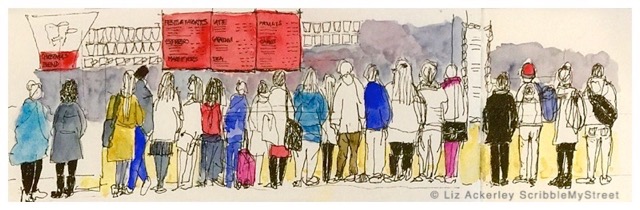
The beautiful drawings in this blog are all by Manchester based artist Liz Ackerley, an inspiration in this playwriting process, (She’s graciously allowed the use of her images here).
I’ve dipped into Liz’s visual world as I’ve developed the first draft of I Love You Baby and as I move forwards (With Director’s hat on) into thinking about rehearsal room exercises and improvisations for the actors, in preparation for the scratch performances, her drawings feature large in my contextualisation of the onstage activity.
Place and a sense of it are very important when building an imagined world, for playwright, actors and designers alike.
Each of us in the creative team will have our own reference points and these are mine.
I know Salford a little but Liz’s drawings have helped me to root my internal view of Samantha’s penthouse apartment, and what surrounds it, into a reality- not a photographic one as this is too stark somehow- but an interpretation of a place which falls in well with the landscape I imagine.
Before making the move into the urban world at the beginning of the play Clarence lived with his elderly mother in a cottage in the East Riding of Yorkshire.
The drawing above took me into Clarence’s past, a context he grieves for.
Liz’s drawings in the countryside have provided Clarence’s memories for me, which in turn inform his choices in the moment-to-moment activity of the play.
The sense of somewhere remote, with an established community and rural feel was important when developing his character and thinking about the clash of culture he experiences when he moves from east to west into Samantha’s apartment on the other side of a busy Manchester.
Middle sister Grace is a nurturer and professional carer for dogs of varying pedigrees and this drawing of a greyhound called Tanzi would be just the kind of thing she’d like to have on her wall in her living room in her house adjoining kennels somewhere in the Pennines.
Younger sister Sadie comes to Salford from London and Liz’s drawing of Camden Lock drew me into an area north of the river which makes sense for Sadie’s night-life focused existence- the image below resonated.
The context I’ve drawn from Liz’s work has been invaluable and demonstrates one of the principals of playwriting in particular and theatre-making in general.
It’s a collaborative medium.
Novelist’s novel away in private and can choose never to meet or communicative with their readers, their publishers, their cover designers and the people who put their book into a carrier bag and sort out the change. A solitary process and a single vision.
Writing a play involves a single vision at the outset but from a first draft onwards (In my case, usually) the glimmering light of that original idea ignites various other tapers in a long journey towards production and beyond.
Playwrights write for creative teams, directors, designers, actors and composers, production teams, technicians and stage managers and venues, marketeers, front of house teams, groups of specific people who the play may be of interest to, and ultimately- hopefully- any human being in pursuit of a story and ideas that entertain and engage.
I Love You Baby has entered the ‘opening out’ phase of the work.
In October I’ll direct the first process workshops for interested people, followed by a scratch performance in the round at project partners the Stephen Joseph Theatre, working with Artistic Director Chris Monks and Outreach officer Cheryl Govan to interest and engage a new audience.
Next week I’m at project partners Dark Horse who are resident at the Lawrence Batley Theatre in Huddersfield, auditioning actors for the role of Tyler. I’m also working with Matthew Eames at further project partners The Lowry in Salford, in anticipation of the scratch performance there in November and I’m beginning a series of discussions with the set and costume designer and the digital projection designer for the planned ultimate production alongside some initial swimming in the aural landscape with the composer. Seven further actors are about to start their journey with the play and dozens of other people will input into it’s development over the next few weeks.
Playwriting is not for the introverted garret-residing fedora wearer, it’s a carnival of collaboration happening both on the street below and up close and personal, terrifying and exhilarating by turns.
He has thousands of recipes stored on his computer.
He used to pick fresh ingredients from the garden and the greenhouse at the cottage he shared with his Mum.
Now she’s gone and he’s moved into Samantha’s apartment he uses the supermarket for ingredients instead.
This is one of Clarence’s favourite recipes which he’s just added to his database.
Bon appetit.
Summer salmon salad
275g small tomatoes (Home grown are the best)
1 tbsp of olive oil
I crushed garlic clove, two if you’re feeling adventurous
I whole bunch of spring onions
250g of puy lentils (You can buy these in packets ready cooked from the Tesco Express across the road)
I tbsp of red wine vinegar
A handful of rosemary picked from next to the strawberry beds high up where the cat can’t get to it
A twist of thyme from the trough outside the kitchen window
One small chilli pulled from the plant on the coffee table
Or all/any of the above bought from the shop
70g of rocket or spinach leaves
2 salmon fillets already cooked and chilled (Tesco’s do these too)
1. The Aga needs to be hot. If you don’t have an Aga and live in on the 14th floor of a building instead where you can’t have one because it would fall through the ceiling apparently then preheat the oven to 180c or gas mark 4. Cut the tomatoes in half and put them onto a baking tray with some of the herbs sprinkled over the top. Cook for about 20 minutes. Long enough for a medium sized cup of tea and a rich tea biscuit. Take them out of the oven and let them cool down for a while.
2. Heat the oil in a big well sealed frying pan or one of Samantha’s fancy copper pots which are very heavy to lift up, difficult to clean and which you can’t get a proper stir going in. Put the garlic in and after a minute or so add the spring onions. Cook and stir as best you can for 1 to 2 minutes until they brown a little and then add the cooked lentils and fry for about 5 minutes until they’re heated through. The smell is lovely and woody. Like having a fire at the end of the cottage garden at sunset. Take them off the heat and let them relax for a bit. Its important that humans do that too sometimes they say. Don’t they?
3. Go back to the pan which is now cooler, not cold, but warmish. Now add the oven-roasted tomatoes and the red wine vinegar and mix together gently. Then put the green leaves in and stir them a little too, gently. Spoon into bowls which you’ve warmed in the Aga- no the microwave, you can heat them in the microwave- and serve with the salmon fillet on the top and the rest of the herbs. You can eat it at the dining table with someone you love. Or you can eat it on your own at the breakfast bar looking out over the city. It tastes the same in both places. It just feels different. Emptier.
You say participate, I say encounter…Let’s call the whole thing off.
The role of audience member in theatre currently takes two main forms.
The first form is participatory and it’s all the rage.
Being a participant audience member can mean: becoming a character in a live narrative, handling props, wearing a costume and being a member of a militia/choir/dystopian nation, choosing dramatic outcomes, shooting a gun, working the lights, cracking open a fluorescent baton, conducting the orchestra, writing the script, pressing buttons, singing, waving children at motion sensors, having your selfie blown up and projected to thousands of people and all possible manner of physical and emotional intervention and immersion in the event/concept/performance.
The second form, encountering theatre most usually means buying a ticket and watching actors deliver a piece of drama in a venue.
Encountering can pale due to the sheer novelty value, va-va-voom and occasional excellence of participation. ‘I’m going to pay twenty five pounds to sit in a seat in a dark space and
watch craftspeople deliver Peer Gynt’ feels distinctly dry when the participatory alternative is to run down the High Street with a flaming torch dressed as a troll while Bjork booms out of the back of a lorry, especially when it’s also absolutely free to wear the wicked hats with horns.
Both kinds of audience experience can live happily side by side but when one form begins to supercede the other in terms of both audience interest and economic expediency then there are some tough questions for producers to answer.
Have audiences had enough of high ticket prices in places they have to travel to, and do they want instead to be an active part of an experience which comes to them, and is often free? Is the whole idea of paying to watch theatre professionals at the top of their game old fashioned?
Theatre’s old and new have been built, and continue to be run, at public expense to house audiences watching works on stages. Actors, technicians, playwrights and directors are trained to work in these purpose built spaces. If the audience is less interested in the work on the stage than in the site specific piece taking place in a caravan in the car park then there is a clear dissonance.
Both experiences can be excellent or dire. Both can engage or repel.
At cost of sounding like an audience theorist with an axe to grind perhaps one can inform the other and the new golden age of (Fanfare or raspberry here if you wish to participate and internal rumination if you are simply encountering the blog experience) encounterpation can begin.
I like theatre spaces, love them in fact, love working in them and visiting them as an audience member and on both counts have a vested interest in seeing them thrive.
I want audiences to come to see I Love You Baby and am aware that working from the outset with an eye to audience engagement is crucial.
In preparation for this autumns scratch performances I’m chewing over central questions about who the production is pitched towards and how to make elements of participation- as it’s now understood- work inside a theatre venue (In order to attract an audience happily engaged by participation into an ‘encounter’ space). Traditionally this has been done through compelling writing and engaging performances and the aim is certainly to do that- but also to add a whole new layer of experience for theatre-goers whose expectation of visual and aural stimulation and control over theatrical activity is key.
At every stage of life we engage as audience, most usually in the context of social ritual, and its a collective experience. Everybody learns that it’s appropriate to make certain sounds when seeing a new baby, to chant at a football match, to smile and look delighted when watching someone else open a birthday present, and how to make the right noises and facial expressions for accidents and announcements, gauging the reactions of others around us and modifying as necessary.
Audience behaviour is society at its most conventional and least independent (As fascist dictators have always known to everybody’s cost) and this perhaps is one of the reasons why it’s approached with a degree of suspicion and fear. The praise or admonishment of the crowd is a primeval thing, ask any actor who’s been in a controversial play. Effective theatre in all its manifestations is powerful, and needs an audience, and is hard to control, there’s no getting away from that fact. (Retreating behind a cloak of non- hierarchical participation is in my opinion disingenuous as it simply means the auteurs directors and writers are hidden, let’s not kid ourselves that they’re not still there).
Theatre lives or dies by the reaction of the crowd. And a crowd being led by a story is still a crowd being led. A crowd or an audience given a decision, over life or death, or over the outcome of a drama, is very powerful indeed. We were all urging the Emperors thumb up or down in the Coliseum, we’re all urging Simon’s yes in the X factor and the roar of the crowd when the right choice- or the wrong- choice is made is the universal stuff of great drama.
Religious rituals are often active and physical, pilgrims encircling the haag are engaged in a visceral communal experience.
It’s possible to have an audience with the Pope and doctors still enjoy a healthy front row when operating in theatres.
We aim for a large house when getting married and perhaps an even larger one when leaving for the next room.
At both weddings and funerals the role of audience is clearly defined. In both instances encounterpationists wait for a very long time with good humour, listening, throwing things, eating and drinking and dancing, the sole difference between the two being the direction in which the flowers are hurled.
We know how to behave due to family lore and popular culture, the bulk of the UK population having gained most of its learning for these pivotal life events via Eastenders and Coronation Street.
Everyone knows where they are with these real life happenings where we’re called upon to be audience.
We know what to wear, what to expect, how to behave and that there’s usually something in all of them that is in some way, if not enjoyable, then certainly cathartic.
The issue with theatre and audience right now perhaps is that those expectations and the role isn’t quite so clear and rather than handing over the reins to the audience and balking the question, we need perhaps to make sure that what we’re delivering both inside the buildings and outside is something that people feel ownership and ease with.
Encounterpation will be central to thinking about engagement for I Love You Baby, and it starts with a firm promise never to use that word again.